
Bocce scoring basics
Bocce is about getting your four balls closer to the pallino (the jack) than the other team. Most games go to 12 or 15 points. It is a straightforward game of precision that anyone can pick up in a few minutes.
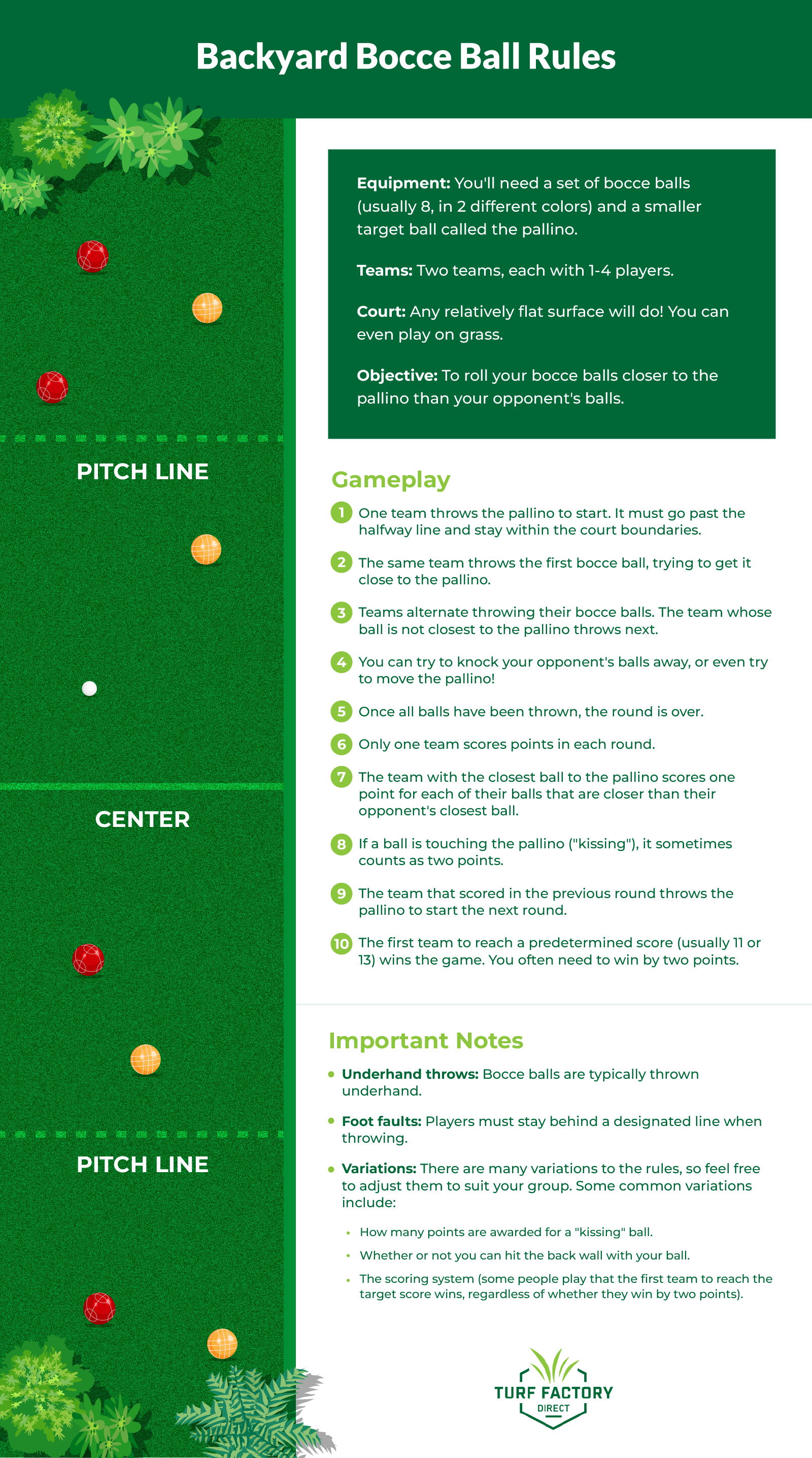
To start a frame, one team throws the pallino. It needs to land beyond the foul line, and within the designated playing area. Then, the same team throws their first bocce ball, attempting to get it as close to the pallino as possible. After that, the opposing team throws their balls, trying to either get closer to the pallino or knock their opponent's balls away. Play alternates until all eight bocce balls are thrown.
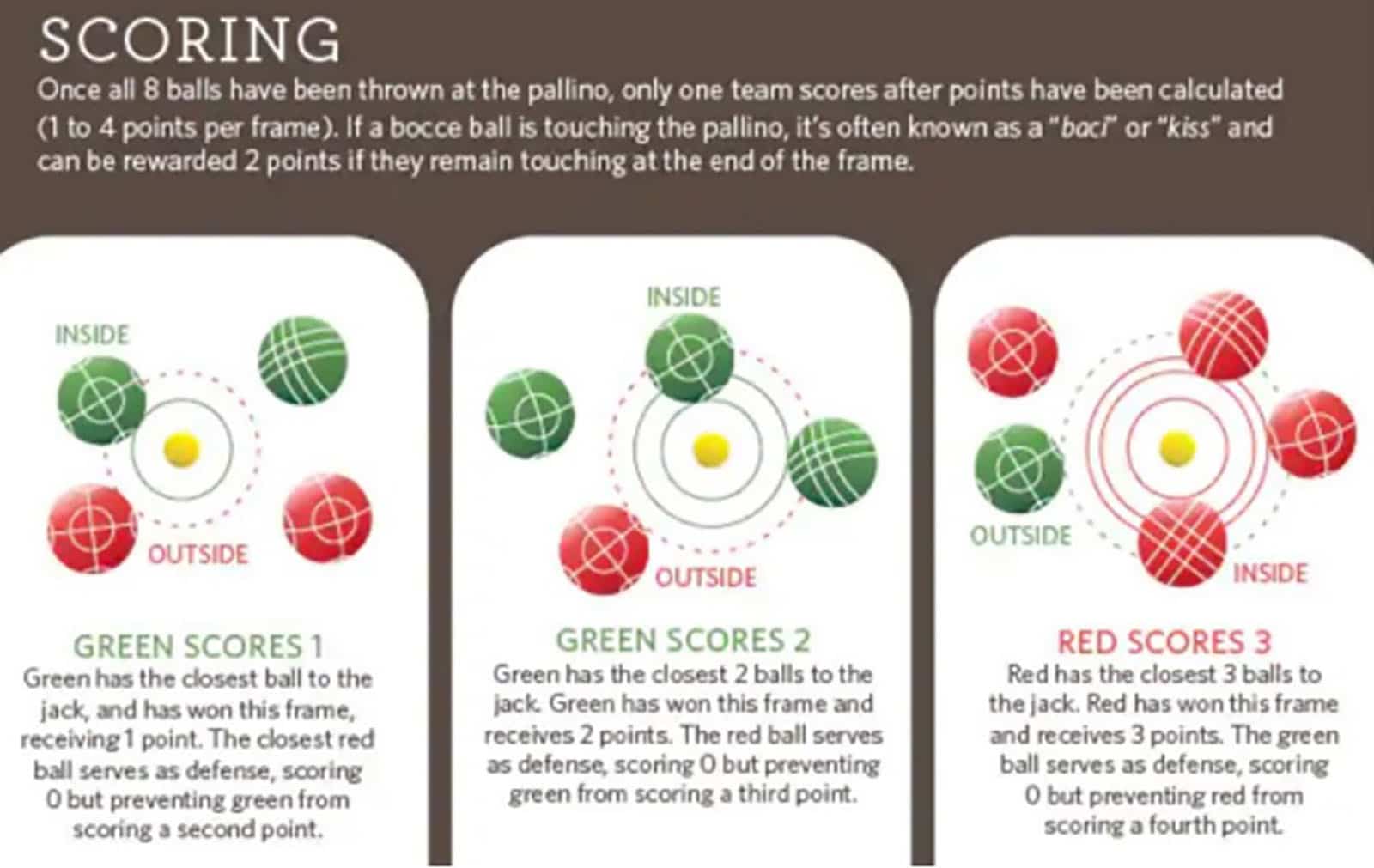
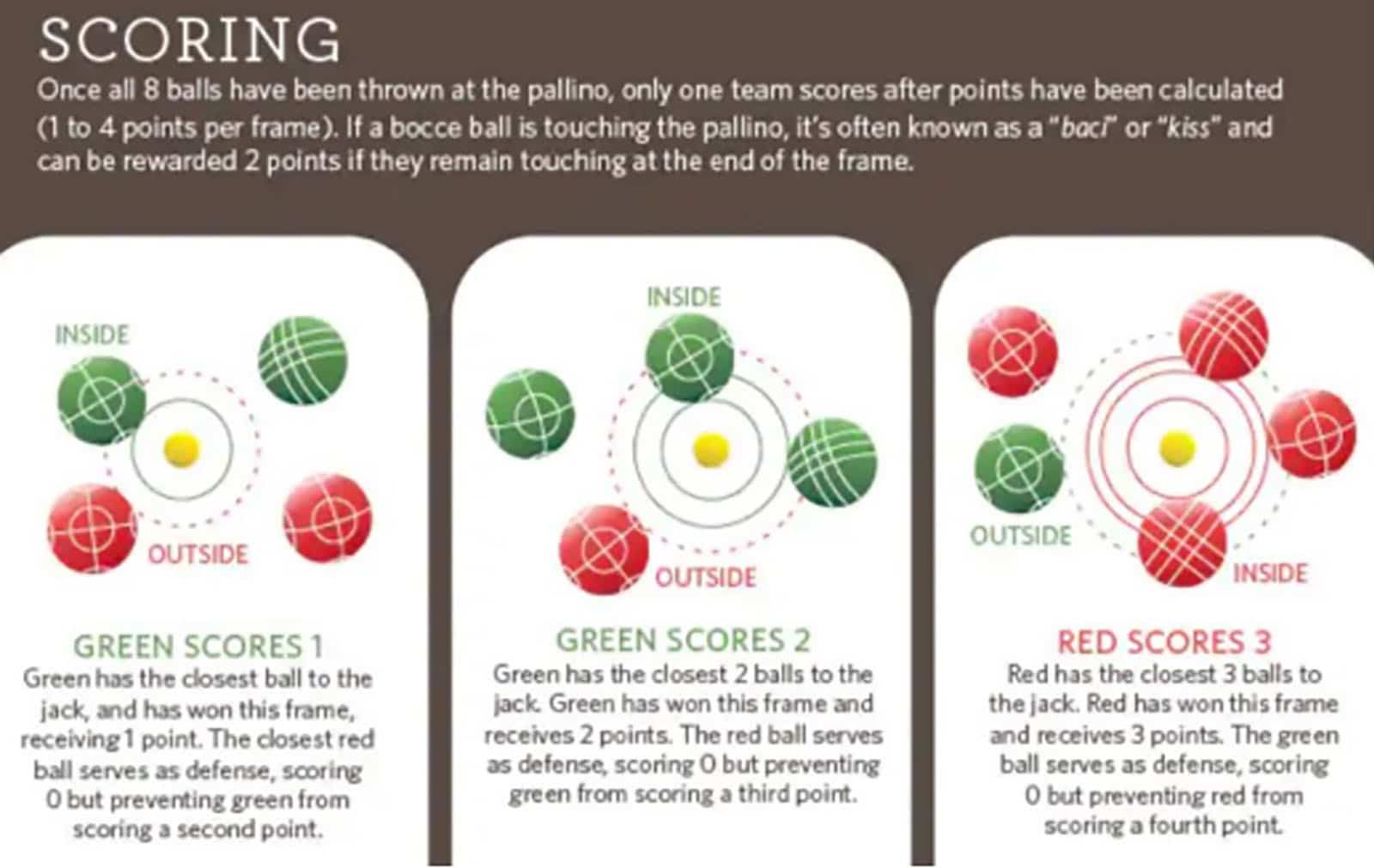
Scoring happens at the end of each frame. Only one team can score per frame. The team with the ball closest to the pallino earns one point for each of their balls that is closer than the closest ball of the opposing team. So, if you have three balls closer than their best, you score three points. It sounds a little complicated, but it becomes clear quickly once you start playing.
How points work
Let’s say Team A throws a ball six inches from the pallino, and Team B’s closest ball is a foot away. Team A gets one point. Then Team A throws another ball four inches from the pallino. Now Team A has two balls closer than Team B’s closest, earning two points. This continues until all balls are thrown and the distances are measured.
A common source of confusion is what happens when balls are touching the pallino. A ball touching the pallino is considered closer than a ball that isn’t. Overlapping balls are also a situation that comes up. If two balls from opposite teams are touching, you measure from the leading edge of each ball to the center of the pallino. It's a bit fiddly, but crucial for accurate scoring.
Only balls closer than the opponent's best ball count. If you have one ball an inch away but your opponent has two balls at two inches, you still only get one point. The score is based on who is closest, not just how many balls are near the jack.
Winning a Frame & a Match
A team wins a frame by having the highest total points at the end of the round. Those points are then added to their overall score. The first team to reach 12 points typically wins the match, but this can be adjusted. A key rule is that you must win by at least two points. So, if the score is 11-10, play continues until one team leads by two.
Most matches are played as a 'best of three' or 'best of five' series of games. This means the first team to win two or three games wins the overall match. This format adds another layer of strategy, as teams adjust their play based on the previous results.
Ties are rare, but they do happen. If a tie occurs at the end of a frame, that frame is simply replayed. It’s a clean slate, and teams start from scratch. This ensures that a clear winner is determined for each frame, and ultimately, for the match. The GoSports® Bocce Ball Game Rules confirm this basic structure.
- Find which team is closest to the pallino.
- Award one point for each ball closer than the opponent’s closest ball.
- Add the points earned in the frame to the team’s overall score.
Digital scorekeeping apps
Manual scoring gets old during long matches. In 2026, Bocce Score Pro and BocceTrack are the standard apps for iOS and Android. Bocce Score Pro is the simple choice for casual games.
BocceTrack, on the other hand, is more feature-rich. It allows you to track player statistics, manage multiple matches, and even generate reports. It’s geared more towards serious players and tournament organizers. While both apps are generally accurate, user reviews sometimes mention occasional glitches with point calculations in BocceTrack, particularly with complex frame scenarios.
Usability is a key difference. Bocce Score Pro is very intuitive, with a minimal learning curve. BocceTrack has a steeper learning curve due to its extensive features. Both apps offer the ability to customize game settings, such as the winning score and the number of frames. Accuracy is generally high in both, but it’s always a good idea to double-check the app’s calculations, especially in close games. They typically cost around $4.99 to $9.99 as a one-time purchase.
Tournament rules
Tournament play brings a more formalized set of rules, often stricter than casual games. One key difference is the treatment of 'dead balls'. A dead ball is one that is thrown illegally – for example, thrown before the pallino is in play or thrown from outside the designated foul area. Dead balls are immediately removed from play and do not count towards the score.
Measuring disputes are also handled differently in tournaments. Typically, a designated official makes the final decision on ball proximity. They may use specialized measuring tools, like digital calipers, to ensure accuracy. Tournament rules often specify a time limit for each throw, to keep the game moving at a reasonable pace.
There isn’t a single, universally recognized governing body for bocce ball, so rules can vary slightly between tournaments. However, most tournaments adhere to the standards set by Bocce Builders of America. It’s always best to check the specific rules of the tournament before playing. They often have detailed guidelines regarding ball placement and measurement procedures.
Bocce Ball Scoring Rule Comparison (2026)
| Rule | US Bocce Federation (Typical Tournament) | Local League (Common) | Backyard/Recreational Play |
|---|---|---|---|
| Winning Score | Typically first to 12-15 points, winning by 2 | Often first to 12 points, winning by 2 | First to 12 points, winning by 2 is common, but adjustable |
| Pallino Placement | Must be within designated court boundaries; specific distance requirements may apply | Generally within the court, but may allow for more flexibility | Within the playing area, often with less strict boundaries |
| Dead Ball | A ball that leaves the playing area is considered dead and removed | A ball that leaves the playing area is considered dead and removed | A ball that leaves the playing area is considered dead and removed |
| Measuring Close Calls | Official measurements are used to determine closest balls; electronic measuring devices are increasingly common | May use visual assessment or a simple measuring tool (tape measure) | Visual assessment is typical |
| Point Awarding | One point awarded for each ball closer to the pallino than the opponent's closest ball | One point awarded for each ball closer to the pallino than the opponent's closest ball | One point awarded for each ball closer to the pallino than the opponent's closest ball |
| Frame Completion | A frame ends when all balls have been thrown | A frame ends when all balls have been thrown | A frame ends when all balls have been thrown |
| Match Format | Matches often consist of multiple rounds (e.g., best of three) | May be a single round or a series of rounds | Typically a single round or until a predetermined score is reached |
Illustrative comparison based on the article research brief. Verify current pricing, limits, and product details in the official docs before relying on it.
Measuring for Proximity: When It Matters
Accurate measurement is paramount, especially in competitive play. The most common tool is a bocce ball measuring tape – a flexible tape measure specifically designed for this purpose. These tapes are typically marked in inches and millimeters. Another option is a digital caliper, which provides a more precise measurement, but can be more expensive.
The standard technique is to measure from the leading edge of the ball to the center of the pallino. It’s important to keep the tape measure flat and aligned with the center of the pallino. When measuring balls that are close together, it can be helpful to use a small, flat object – like a card – to help maintain the alignment.
Disputes are inevitable. If players disagree on a measurement, the best approach is to have a neutral third party make the final decision. It’s also a good idea to agree on the measuring method before the game starts. Maintaining a respectful and sportsmanlike attitude is essential, even when disagreements arise.
House Rules & Variations
Bocce ball is often played with 'house rules' – variations that players agree on before the game. Some common variations include allowing players to knock the pallino out of play (which resets the frame) or awarding extra points for particularly skillful shots. These rules add a fun, social element to the game.
Another popular variation is the 'around the clock' rule, where players must throw their balls in a specific order around the pallino. This adds a strategic challenge and encourages players to develop different throwing techniques. Ultimately, the best house rules are those that everyone agrees on and that enhance the enjoyment of the game.
Don’t be afraid to experiment and find what works best for your group. Bocce ball is a game that’s meant to be enjoyed, and a little bit of flexibility can go a long way.
What's the most common house rule you play with?
Vote below!
No comments yet. Be the first to share your thoughts!