
Set up the court and balls
Start by clearing a flat, level area at least 12 by 45 feet. You can play on dirt, crushed stone, or a hard-packed surface. The ground needs to be smooth enough that the balls roll true without catching on pebbles or roots. Mark the boundaries with tape or chalk if you are playing on grass or pavement.
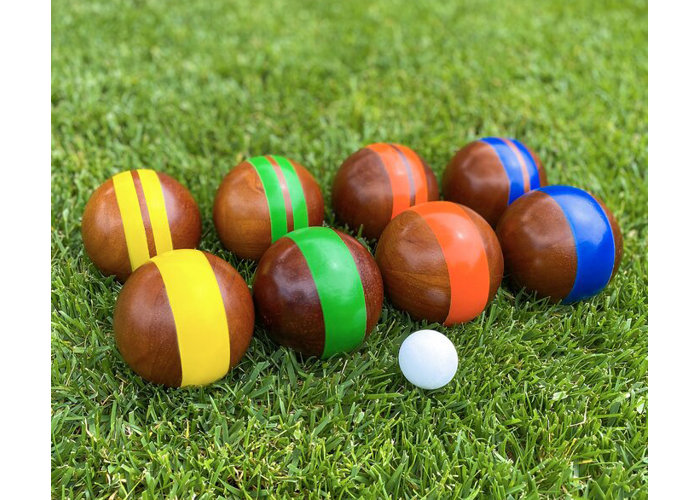
You need eight large balls and one smaller target ball called the pallino. The eight balls are split evenly between two teams, with each team getting four balls. Traditionally, two balls are red and two are yellow, though color sets vary. The pallino is usually white or yellow and is significantly smaller than the playing balls.
Place the pallino in the center of the court to start. Teams take turns throwing their balls, trying to land them as close to the pallino as possible. The first team to throw all four balls scores points based on how many of their balls are closer to the pallino than the opponent's nearest ball. Keep the playing area clear of distractions and ensure everyone has enough space to throw without hitting others.
Master the underhand throwing motion
Bocce is not a game of power; it is a game of touch and trajectory. The underhand throw is the foundation of every successful shot, whether you are placing a ball near the pallino or knocking an opponent away. Most beginners make the mistake of treating the ball like a baseball, leading with their shoulder and snapping their wrist. This approach sends the ball bouncing unpredictably or sailing long.
To master the underhand throw, you must let the ball fall naturally from your hand. The motion should feel smooth and pendulum-like, not jerky. Focus on a consistent release point and a gentle follow-through. This section breaks down the mechanics into three simple steps to help you find your rhythm.
Hold the bocce ball in your dominant hand with your fingers spread evenly across the surface. Do not squeeze it tightly; a firm but relaxed grip allows for better control. Your palm should face downward, and your wrist should remain straight, not cocked back. Think of the ball as an extension of your arm, not an object you are trying to propel.

Stand sideways to your target, with your non-dominant foot slightly forward. Keep your knees bent and your body balanced. As you begin the throw, shift your weight smoothly from your back foot to your front foot. This forward momentum provides the necessary force without requiring arm strength. Keep your head up and your eyes locked on the target area.
Let your arm swing down naturally like a pendulum. As the ball passes your knee, allow it to roll off your fingers. The release point should be low and consistent. Follow through by letting your arm continue its forward motion toward the target. Avoid snapping your wrist or pulling back abruptly, as these actions introduce unwanted spin and direction errors.
-
Keep your wrist straight throughout the motion
-
Release the ball at knee height
-
Follow through toward the target
-
Practice with a stationary pallino first
The key to consistency is repetition. Start by practicing your form without a target, focusing on the smoothness of the swing. Once you feel comfortable with the motion, place the pallino at a short distance and aim for accuracy before adding distance. Over time, this relaxed underhand technique will become second nature, giving you the precision needed to compete effectively.
Choose between point and shoot shots
Every throw in bocce comes down to one decision: do you want to place your ball close to the pallino, or knock an opponent’s ball away? These are the two core strategic shots in the game. Understanding when to use each one separates casual players from those who consistently score points.
The first option is the point shot. You aim to land your bocce ball as close to the pallino as possible without hitting it. This is the primary way to score. If your ball is closer to the target than any opponent’s ball, your team earns a point for every ball that is nearer than the opponent’s closest ball. Point shots require finesse, a soft touch, and a good sense of distance. They are most effective when the court is clear of other balls or when you are trying to secure a safe position for the next throw.
The second option is the shoot shot. Here, you aim your ball directly at an opponent’s ball to knock it away from the pallino. This is a higher-risk, higher-reward play. A successful shot removes a threat from the court and can change the entire scoring dynamic of the round. However, if you miss, you might leave your own ball in a bad position or even hit the pallino, which gives the point to the opposing team. Shoot shots are best used when an opponent has a ball very close to the pallino that you cannot beat with a point shot.
To help you decide which shot to take in the moment, compare the two approaches below.
| Feature | Point Shot | Shoot Shot |
|---|---|---|
| Goal | Land close to the pallino | Knock opponent’s ball away |
| Risk Level | Low | High |
| Skill Focus | Finesse and distance control | Aim and power |
| Best Used When | Court is clear or securing points | Opponent has a ball very close to the pallino |
Seeing the difference in motion helps clarify the technique. Watch this demonstration to see how players switch between placing and shooting during a match.
Use this checklist to decide your next move during a game:
- Is there an opponent’s ball blocking the pallino? If yes, consider a shoot shot.
- Is the court mostly clear? If yes, aim for a point shot to secure points.
- Are you trailing by a large margin? If yes, take a higher-risk shoot shot to disrupt the opponent.
- Is the pallino very far from the current closest ball? If yes, play conservatively with a point shot to maintain your lead.
- Do you have a clear path to the opponent’s ball? If no, avoid a shoot shot and try to place your ball elsewhere.
Fix common throwing mistakes
Even experienced players can develop bad habits that throw off their aim. The most frequent error is using too much arm strength. Bocce is a game of finesse, not power. When you throw with excessive force, the ball tends to bounce or skid unpredictably across the court. Instead, focus on a smooth, controlled release. Think of it like rolling a bowling ball gently down a lane. You want the ball to travel straight and settle softly near the pallino.
Another common issue is releasing the ball too early or too late in your swing. If you let go too soon, the ball will fall short. Letting go too late often causes it to veer wide. To fix this, practice your follow-through. Keep your arm extended toward the target after the release. This consistency helps ensure the ball travels in the intended direction.
Watch the video above to see the proper form in action. Notice how the player keeps their body steady and their eyes on the target throughout the motion. Imitating this stance can help you correct your own technique quickly.
Checklist for your next throw
- Stand with feet shoulder-width apart for balance.
- Hold the ball firmly but without tension in your hand.
- Swing your arm back smoothly, keeping it close to your body.
- Release the ball at the bottom of the swing, not at the top.
- Follow through toward your target, holding the pose for a second.
- Watch the ball’s path to adjust your next throw.
How Bocce Scoring Works
Bocce scoring is straightforward but demands precision. Only the team closest to the pallina earns points. After all eight balls from both teams have been thrown, you count how many of your balls are closer to the target than the opponent’s nearest ball.
For example, if your team has three balls closer to the pallina than the opposing team’s best ball, you score three points. If your opponent has the closest ball, they score zero. It is impossible to score negative points; the game is purely about relative position.
A standard game ends when a team reaches a set point total, typically 11 or 16 points, depending on local house rules. The first team to reach that threshold wins the match.
FAQs about bocce ball rules
Here are the most common questions beginners ask when learning how to play bocce ball. These answers clarify the basics so you can get straight to throwing.
No comments yet. Be the first to share your thoughts!