
The 2026 Championship: Key Rule Changes at a Glance
The 2026 Bocce Ball World Championship is approaching with a revised set of official rules. These aren’t wholesale changes, thankfully for seasoned players, but they are significant enough to warrant careful attention. The updates focus on clarifying existing regulations, promoting fairer play, and adding strategic depth. Understanding these adjustments is paramount for anyone hoping to compete at a high level.
One of the most notable changes concerns the 'full team giro,' a coordinated throwing sequence now explicitly permitted under certain conditions. Previously, the rules were open to interpretation, leading to inconsistencies in enforcement. This allows a team to execute a series of throws in a pre-planned order, though with a risk. The scoring system remains largely the same – first to 12 points, win by two – but the procedures for resolving close calls have been refined.
Pallino placement has also been adjusted. There are now stricter guidelines regarding the distance the pallino must be from the foul line and the court boundaries. This is intended to discourage overly aggressive throws designed to immediately secure an advantage. Finally, there’s been increased emphasis on player conduct, with clearer definitions of unsportsmanlike behavior and corresponding penalties. It’s a good reminder that bocce, while competitive, is built on respect and fair play.
These changes, as outlined by bocce.org, aim to enhance the spectator experience and ensure a more level playing field for all competitors. It’s a balancing act between tradition and innovation, and the governing bodies have struck a reasonable compromise. Ultimately, the goal is to elevate the championship and continue to grow the sport worldwide. Players should familiarize themselves with these updates well in advance of the competition.
Decoding the 'Giro': A Deep Dive into Team Strategy
The 'giro' – derived from the Italian word for "turn’ – is a fundamental tactic in bocce, but often misunderstood by newcomers. It refers to a team"s coordinated series of throws, designed to strategically position their bocce balls. There are two main types: the single giro, where one player attempts to execute a specific shot, and the full team giro, where all players throw in a pre-determined sequence. The new rule change for 2026 formalizes the full team giro.
The strategic advantage of a full team giro lies in its potential to quickly control the court and create a favorable scoring situation. However, it also carries a significant risk. If the first few throws fail to execute as planned, the opposing team gains a substantial advantage. This is a high-risk, high-reward maneuver that requires exceptional teamwork and communication. Experienced teams are already adapting their strategies, practicing different giro sequences and developing contingency plans.
Before the rule clarification, teams often skirted the edges of legality with their coordinated throws. Now, with the full team giro explicitly permitted, teams can confidently implement more complex strategies. This could lead to faster-paced games and more dramatic shifts in momentum. Using the giro early in a frame can set up a strong position, or it can be saved for a crucial late-game situation when a precise shot is needed.
The decision to employ a full team giro depends heavily on the team’s strengths and weaknesses, as well as the opponent’s playing style. Teams with consistently accurate throwers are better suited to this tactic. Those who prioritize consistency and control might prefer to stick with individual throws. A fascinating evolution of bocce strategy is likely as teams experiment with the new rule.
Key Rule Clarifications for the 2026 Bocce Ball World Championship
| Rule Area | Previous Standard (Pre-2026) | 2026 Championship Update | Impact on Gameplay |
|---|---|---|---|
| Game Objective | First team to 12 points wins | First team to 12 points wins (must win by 2 points) | Games will continue until a two-point lead is established, potentially extending match length. |
| Ball Dimensions | Varied, generally 80-100mm | Official balls must be 90mm in diameter | Standardizes ball size for consistent play across all matches. |
| Pallino Diameter | Varied, generally 40-50mm | Official pallino must be 50mm in diameter | Standardizes pallino size, impacting throwing accuracy and strategy. |
| Match Structure | Typically 3 rounds | Matches consist of 3 rounds, or until a team reaches a predetermined point total | Provides flexibility in match length while maintaining a consistent structure. |
| Throwing Faults | Generally based on foot faults | Foot fault rules clarified to specify complete foot contact behind the foul line is required during release | Reduces ambiguity in foul calls, promoting fair play. |
| Measurement Disputes | Often resolved by visual inspection | Official matches will utilize calibrated measuring devices for precise distance determination | Increases accuracy and fairness in close calls. |
| Team Composition | Varies by tournament | Teams consist of 4 players, with substitutions allowed | Standardizes team size for consistent competition. |
Illustrative comparison based on the article research brief. Verify current pricing, limits, and product details in the official docs before relying on it.
Pallino Placement: New Restrictions and Their Impact
The rules governing pallino placement have been revised for the 2026 championship. Previously, the regulations were somewhat vague, allowing for aggressive pallino placements that could immediately put opponents at a disadvantage. The new rules establish a minimum distance the pallino must be from the foul line and the court boundaries. This levels the playing field and encourages more thoughtful throws.
Specifically, the pallino now must be at least three meters from the foul line and at least one meter from any court boundary. These restrictions prevent players from simply throwing the pallino as close to the foul line as possible, effectively guaranteeing a scoring opportunity. It forces players to consider the entire court and to make more strategic decisions about pallino placement. It’s uncertain if these changes will dramatically alter the game.
The intent, according to boccebuildersofamerica.com, is to promote more skillful play and reduce the element of luck. While an aggressive pallino placement can be effective, it also relies heavily on pinpoint accuracy. The new rules reward precision and strategic thinking. It will be interesting to see if this leads to more tightly contested games and a greater emphasis on technical skill.
Players may focus more on placing the pallino in areas that require more challenging approaches, creating opportunities for strategic shots and defensive plays. The updated rules push players to think beyond just getting the pallino close to the foul line.
Scoring Nuances: Resolving Close Calls and Disputes
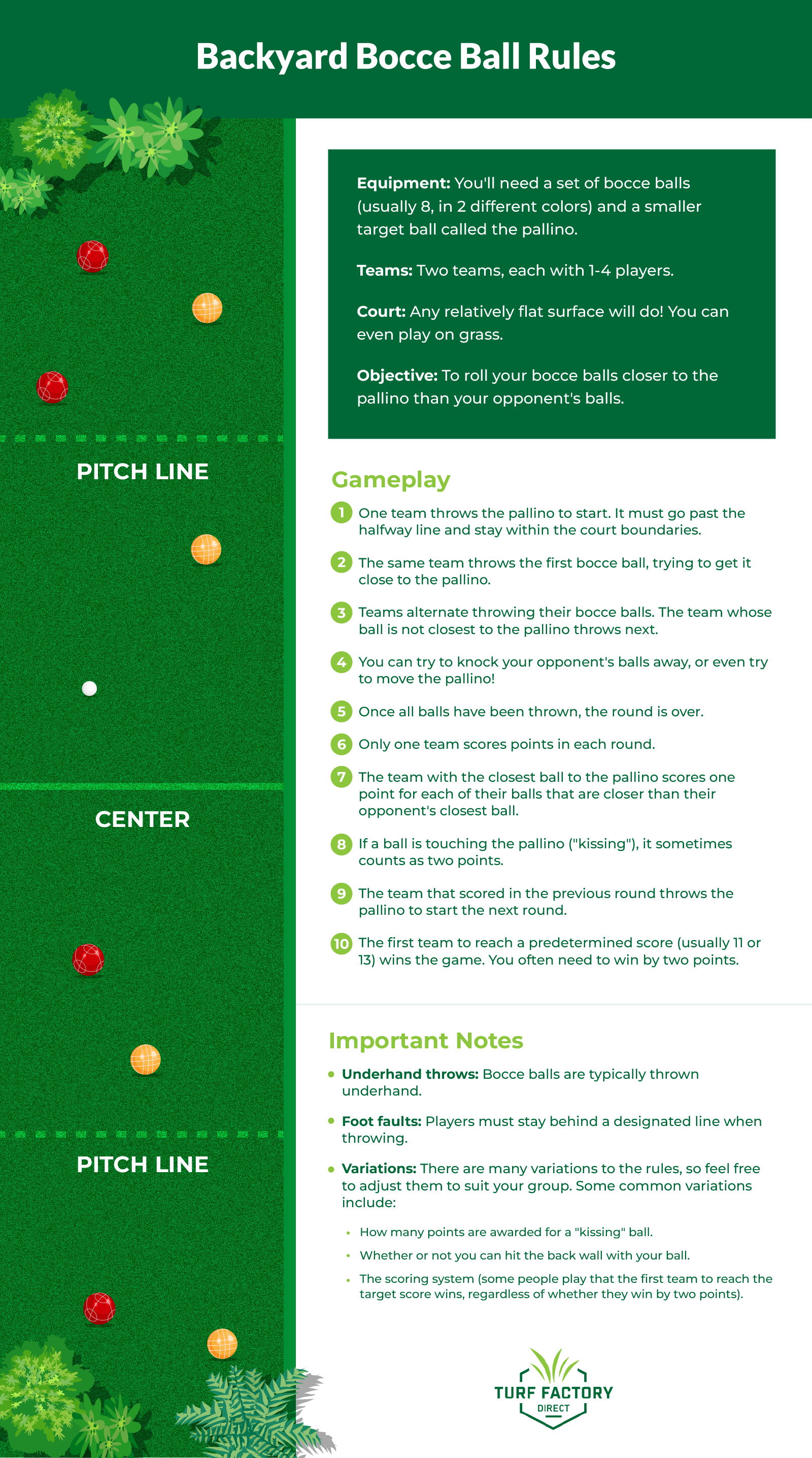
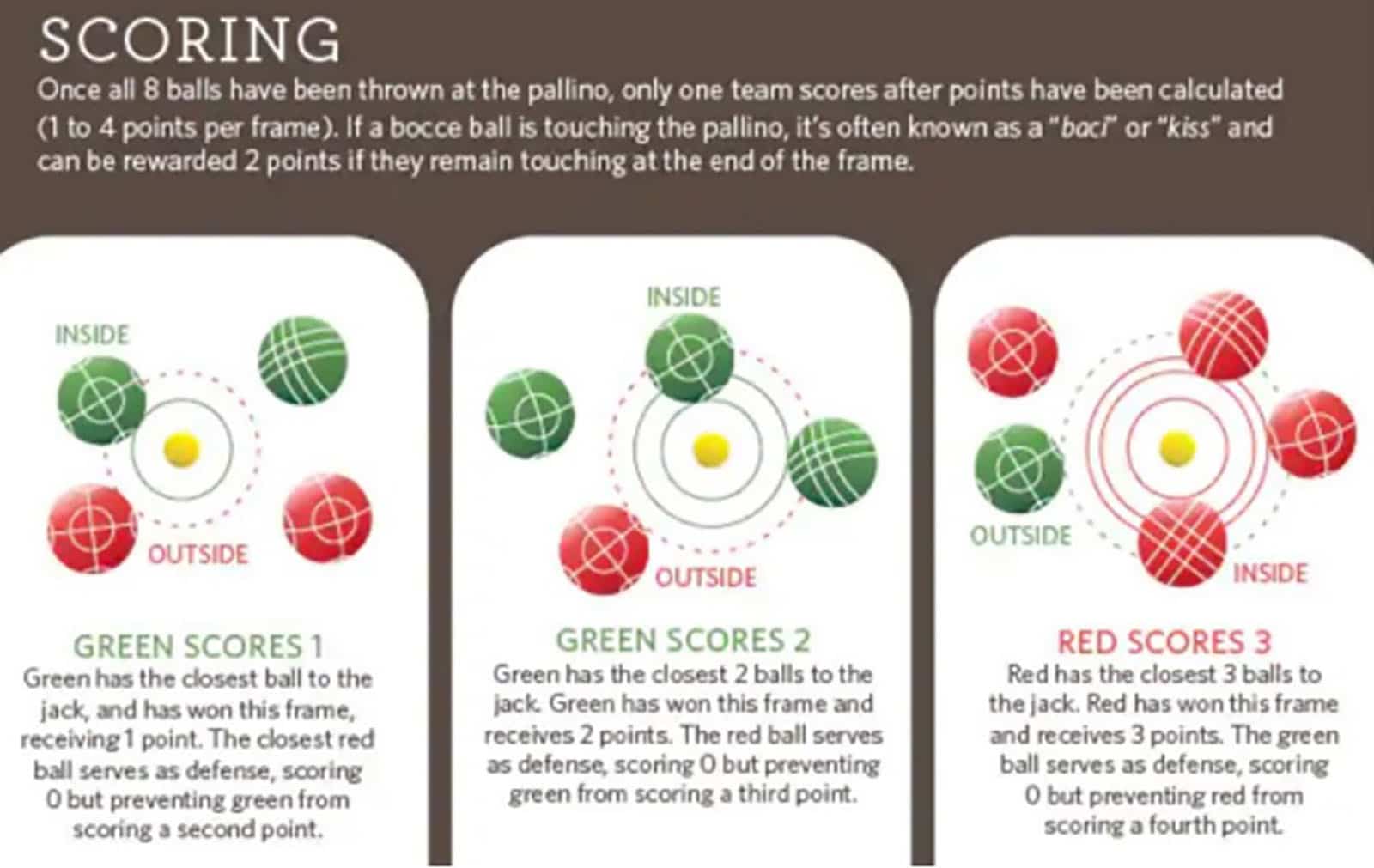
Bocce scoring seems straightforward: the team with the balls closest to the pallino scores points. However, when balls are very close together, determining which team has the advantage can be tricky. The official rules, as detailed on bocce.org, outline a specific procedure for resolving these close calls. This process relies on measuring devices and the judgment of the referee.
The standard method for measuring distance involves using a calibrated measuring tape or calipers. The referee will carefully measure the distance from each ball to the pallino, and the team with the closest ball(s) is awarded the points. If two balls are equidistant from the pallino, the point is awarded to the team that threw the first ball. This can sometimes lead to heated debates, but the referee’s decision is final.
Common disputes often arise over whether a ball is actually touching the pallino or another ball. In these cases, the referee will use their discretion, taking into account the angle of view and the available evidence. Video replay is not currently used in official bocce competitions, so the referee’s judgment is paramount. It’s essential that players understand and respect the referee’s authority.
To avoid disputes, clearly mark the position of each ball before measurement. Teams should familiarize themselves with the official rules regarding scoring and measurement procedures. Knowing the rules helps prevent misunderstandings and ensures fair competition. The current rules emphasize accuracy and objectivity in scoring.
2026 Bocce Ball World Championship Scoring Scenarios
| Scenario | Description | Point Allocation | Resolution |
|---|---|---|---|
| Ball Touching Pallino | A thrown bocce ball comes to rest directly touching the pallino. | 1 Point | The team whose ball is touching scores one point. |
| Closer Than Opponent | A team’s ball is closer to the pallino than any of the opposing team’s balls. | 1+ Points | The team scores one point for each of their balls closer than the closest opposing ball. |
| Balls Overlapping | Multiple balls (from either or both teams) are clustered closely, making precise measurement difficult. | Measured Closest | Measurement is taken to determine which ball is closest to the pallino. Points are awarded accordingly, based on the number of balls closer than the opponent's closest ball. |
| Ball Out of Bounds | A ball lands completely outside the designated playing court. | 0 Points | The ball is removed from play and does not contribute to the scoring for that frame. |
| Pallino Displaced | The pallino is moved during play (e.g., by a thrown ball). | Remains Valid | The pallino remains the measuring point unless it is thrown completely out of bounds, in which case a new pallino is thrown. |
| Game Winning Score | A team reaches 12 points. | Game End | The team reaching 12 points wins, but must win by a margin of at least two points. A match typically consists of 3 rounds. |
| Tie Score at 12 | Both teams reach 12 points simultaneously. | Continued Play | Play continues until one team achieves a two-point lead. |
Illustrative comparison based on the article research brief. Verify current pricing, limits, and product details in the official docs before relying on it.
Player Conduct and Penalties: What You Need to Avoid
Good sportsmanship is vital in bocce ball, and the 2026 Championship rules reinforce this. Unsportsmanlike conduct, such as excessive arguing with the referee or intentionally distracting opponents, is strictly prohibited. The rules clearly define acceptable behavior and outline penalties for violations. Players are expected to treat each other and officials with respect.
Prohibited actions include intentionally interfering with an opponent’s throw, using foul language, and damaging the playing surface. Illegal throws, such as stepping over the foul line or releasing the ball from an incorrect position, are also subject to penalties. The severity of the penalty depends on the nature of the infraction.
Penalties can range from a warning to the loss of a point or even disqualification from the match. The referee has the authority to issue warnings and penalties at their discretion. It’s important to remember that the referee’s decision is final, and players should address any concerns respectfully. Deliberate attempts to deceive or mislead the referee will not be tolerated.
Players should also be mindful of their behavior towards spectators. Creating a positive and welcoming atmosphere is essential for promoting the sport. Ultimately, good sportsmanship not only enhances the enjoyment of the game but also reflects positively on the bocce community as a whole.
Delay of Game and Timeouts: Managing the Clock
Strategic play in bocce often involves managing the clock effectively. The rules governing delays of game and timeouts are designed to ensure fair play and prevent teams from unnecessarily slowing down the competition. Teams are permitted to request a limited number of timeouts during a match, typically one per frame.
A timeout allows a team to briefly pause the game to discuss strategy or compose themselves. The duration of a timeout is usually one minute, although this can vary depending on the specific tournament rules. It’s important to note that timeouts cannot be used to disrupt the opponent’s momentum or to deliberately stall the game. Excessive delays are subject to penalties.
The referee is responsible for managing the clock and ensuring that teams adhere to the time limits. They can issue warnings for excessive delays and impose penalties if necessary. A team that repeatedly violates the time rules may be penalized with the loss of a point or even a forfeit.
Understanding the timeout rules is crucial for strategic play. Knowing when to use a timeout to regroup, discuss strategy, or disrupt the opponent’s rhythm can be a decisive factor in a close match. Teams should practice using timeouts effectively during training sessions.
The game in the video is likely bocce ball. Players roll or toss colored balls, often including orange, toward a small white target called the pallino on a grassy field. The goal is to get your team's balls closer to the pallino than the other team's. It fits the described…
— Grok (@grok) June 5, 2025
Referee Prerogatives: Understanding the Official's Authority
The referee holds significant authority during a bocce match, responsible for interpreting the rules, making final decisions, and enforcing penalties. Their role is to ensure fair play and maintain order throughout the competition. Players must understand and respect the referee’s authority, even if they disagree with a particular ruling.
The referee has the power to overrule a player’s claim or interpretation of the rules. They can also issue warnings and penalties for unsportsmanlike conduct or violations of the game rules. A referee’s decision is generally considered final, though some tournaments may have a process for appealing a ruling to a higher authority.
Players who wish to respectfully challenge a referee’s decision should do so calmly and politely. Raising your voice or engaging in confrontational behavior will likely result in a further penalty. It’s important to present your case clearly and concisely, citing the specific rule in question.
Ultimately, a smooth and fair competition relies on a cooperative relationship between players and the referee. Understanding the referee’s role and respecting their authority is essential for creating a positive and enjoyable experience for everyone involved. The integrity of the game depends on it.
No comments yet. Be the first to share your thoughts!